 Izumi
Izumi combines iZiSwap trading with LiquidBox liquidity incentives and bond financing
Izumi is a multichain decentralized finance (DeFi) protocol that combines token trading, targeted liquidity rewards, and bond-based financing. Its exchange, iZiSwap, supports swaps and on-chain limit orders through a discrete liquidity model. LiquidBox adds incentive programs for eligible liquidity positions, including Uniswap V3 position NFTs. The wider product family includes iUSD and iZUMi Bond. Each product addresses a different task, so its network, position type, and conditions need to match that task.
Updated onSwaps, liquidity provision, and incentives serve different tasks
A swap exchanges one token for another using the liquidity available to the chosen trade. Providing liquidity places assets into a pool so that other traders can exchange against them. Liquidity providers can earn trading fees; a swapper pays the costs attached to the selected trade. LiquidBox adds another relationship by distributing incentive tokens to qualifying liquidity positions. Those incentives come from participating projects and the platform, and their rules belong to the particular program.
iZiSwap's DL-AMM and V2 use different liquidity models
An automated market maker, or AMM, executes exchanges through pool rules. The DL-AMM version of iZiSwap distributes liquidity at discrete price ticks. That structure supports limit orders that specify a trading price, alongside swaps against available liquidity. Concentrating capital at particular prices changes where that capital can support trading, making the distribution of liquidity relevant to the exchange rate available for a swap.
A fixed order price describes the exchange rate at which an order trades, including an order that fills only partially. The ability to name that rate does not set an execution deadline, so a limit order's specified price and its filled quantity convey different information.
iZiSwap V2 follows a separate constant-product model, where token reserves determine the pool's exchange rate. Liquidity providers deposit equal values of both underlying tokens and receive fungible pool-share tokens. Those positions differ from the NFTs that represent individual concentrated-liquidity positions. The pool-share tokens represent a proportional claim on the underlying reserves and can be redeemed for those assets.
LiquidBox targets rewards to eligible positions
A position NFT records a particular liquidity allocation, including its price range. LiquidBox uses these non-fungible tokens from Uniswap V3 or DL-AMM positions to calculate mining rewards. LiquidBox's fixed-range model counts only liquidity inside its incentive interval toward reward allocation. A position that extends beyond that interval earns weight only for the qualifying portion. Positions narrower than that incentive interval can face a weighting penalty under the fixed-range model.
Other LiquidBox models treat exposure differently. A staked Dynamic Range position can keep earning mining rewards after the market price leaves its range, while its mining program remains active. The out-of-range position no longer earns new trading fees at the market price. The one-sided model pairs a project-token stake outside the trading pool with USDC liquidity below the current price.
That arrangement prevents passive sale of the staked project tokens during price rises. Falling prices can still create impermanent loss.
Trading and funding paths carry different conditions
A pool share, a liquidity NFT, and a bond claim represent different assets and rights.
| Path | Purpose | Key condition |
|---|---|---|
| iZiSwap DL-AMM swaps | Exchange tokens against pool liquidity | Output depends on liquidity and trade size |
| iZiSwap limit orders | Offer tokens at a specified price | Execution can be partial |
| iZiSwap DL-AMM liquidity | Supply liquidity over a selected range | An NFT identifies the individual position |
| iZiSwap V2 liquidity | Supply both tokens to a constant-product pool | Pool tokens redeem for underlying assets |
| LiquidBox | Earn incentives on qualifying liquidity | Eligibility and weighting follow the incentive model |
| iUSD | Represent USD-denominated bond financing | Designed value support uses collateral and revenues |
| Convertible iZUMi Bond issues | Add an option to convert into iZi | The issue's maturity and conversion price apply |
iZi and veiZi link utility with governance
iZi is the platform's utility token for incentive-pool setup and other tool functions. When holders lock iZi, they can mint a veiZi governance NFT. Voting power in the protocol's decentralized autonomous organization, or DAO, weights both the amount locked and the remaining lock time. As the remaining lock time decreases, the same locked balance carries less voting power. Staking veiZi can also boost reward weight in applicable LiquidBox programs, with the pool's earning rules determining the effect.
veiZi follows the ERC-721 NFT standard and can be transferred, while the underlying iZi remains locked until its unlock time. Transferring the NFT changes ownership of that locked position without shortening the lock or creating an early-redemption right.
iUSD and iZUMi Bond add a financing layer
iUSD, short for iZUMi Bond USD, is a bond-financing token designed to track one US dollar. Its design supports USD-denominated value through collateral and protocol revenues. That creates exposure to the backing arrangements and the liquidity available for trading the token. A stated peg describes the target value; it does not establish the price available for every secondary-market sale.
Bond Farming allocates generated revenue to investor repayment before market-maker rewards. That priority determines who receives available proceeds first, without establishing that proceeds will cover every obligation. Repayment still depends on the collateral, revenue generation, and terms of the particular bond issue.
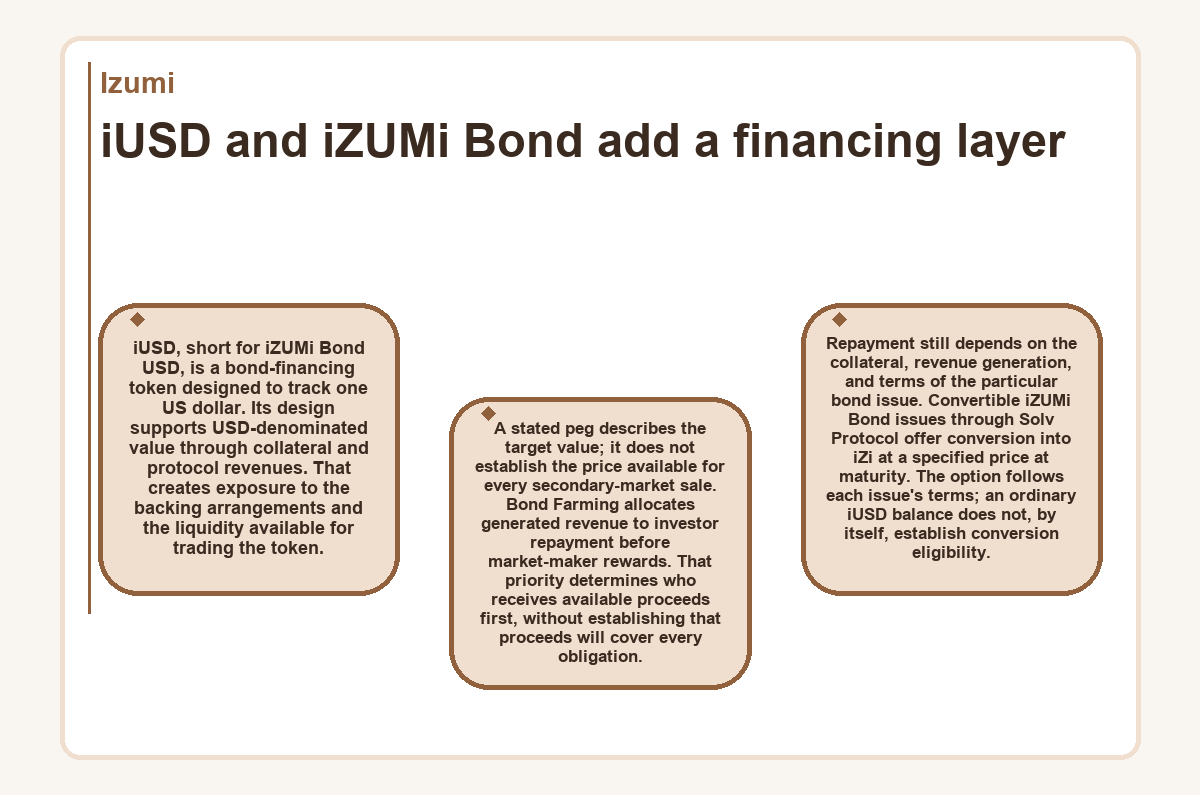
Convertible iZUMi Bond issues through Solv Protocol offer conversion into iZi at a specified price at maturity. The option follows each issue's terms; an ordinary iUSD balance does not, by itself, establish conversion eligibility.
Network deployments remain product-specific
LiquidBox launched with Uniswap V3 on Ethereum and expanded to Arbitrum and Polygon. iZiSwap initially launched its DL-AMM exchange on BNB Chain. The separate iZiSwap V2 model has deployments on Base, Linea, Scroll, and Mantle. These are product-specific deployments, not one shared compatibility list. Support for one product does not establish that every incentive program, position type, or bond arrangement exists there. Compared with choosing by chain name alone, identifying the product and model explains which pool rules and position format apply.
Izumi FAQs
Can I change the fee tier of an existing iZiSwap liquidity position?
You cannot edit the fee tier or price range of an existing iZiSwap DL-AMM liquidity position. Adding more liquidity retains those settings, so increasing a position's size is different from changing its trading configuration.
Where are trading fees stored for a Uniswap V3 position NFT?
Uniswap V3 records accrued trading fees separately from the liquidity represented by the position NFT. Those fees remain in the tokens in which traders paid them. A position's liquidity and its accumulated trading income therefore represent separate amounts.
What does an insufficient-liquidity warning mean during an iZiSwap swap?
An insufficient-liquidity warning concerns the liquidity available for the selected token exchange. The relevant swap details include routing, fees, and price impact. A quote for another pair or route describes a different exchange and cannot establish the outcome for the original selection.
Are private bond placements the only way to acquire iUSD?
The iUSD product design includes secondary-market purchases through Uniswap V3 and iZiSwap, alongside institutional private placements. Secondary-market access depends on an available market for the token. A DEX purchase follows that market's price and liquidity, while a private placement follows its own subscription terms.
How do pool trading fees differ from blockchain transaction fees?
The fee that an iZiSwap pool charges is separate from the network charge for executing a blockchain transaction. Their amounts depend on different inputs: the chosen pool's settings and the blockchain transaction. A mining reward rate does not quote the amount required to submit a transaction.