 Izumi
Izumi LiquidBox targets liquidity mining rewards to selected price ranges
Izumi LiquidBox allocates mining rewards using the price ranges of liquidity provider (LP) NFTs and each program's weighting rules. These non-fungible tokens identify individual positions and the price boundaries that govern their liquidity. Fixed-range programs reward liquidity within a defined band, while Dynamic Range and one-sided models arrange incentives differently. The project offering incentives selects the relevant settings, and the position must satisfy that program's rules. Trading fees and mining tokens also follow different mechanisms: price movement can change trading activity without ending every type of mining reward. Understanding the selected model starts with its eligible liquidity, its reward allocation, and the assets that it places in the trading pool.
Updated onFixed-range, dynamic, and one-sided incentives
Fixed-range incentives concentrate rewards around a chosen band, especially for stablecoins and pegged assets. Dynamic Range initializes liquidity around the market price at entry, with width set by the program. The one-sided model separates the asset supplying pool liquidity from project tokens held in staking. These choices change what qualifies for rewards and how the deposit behaves as price moves.
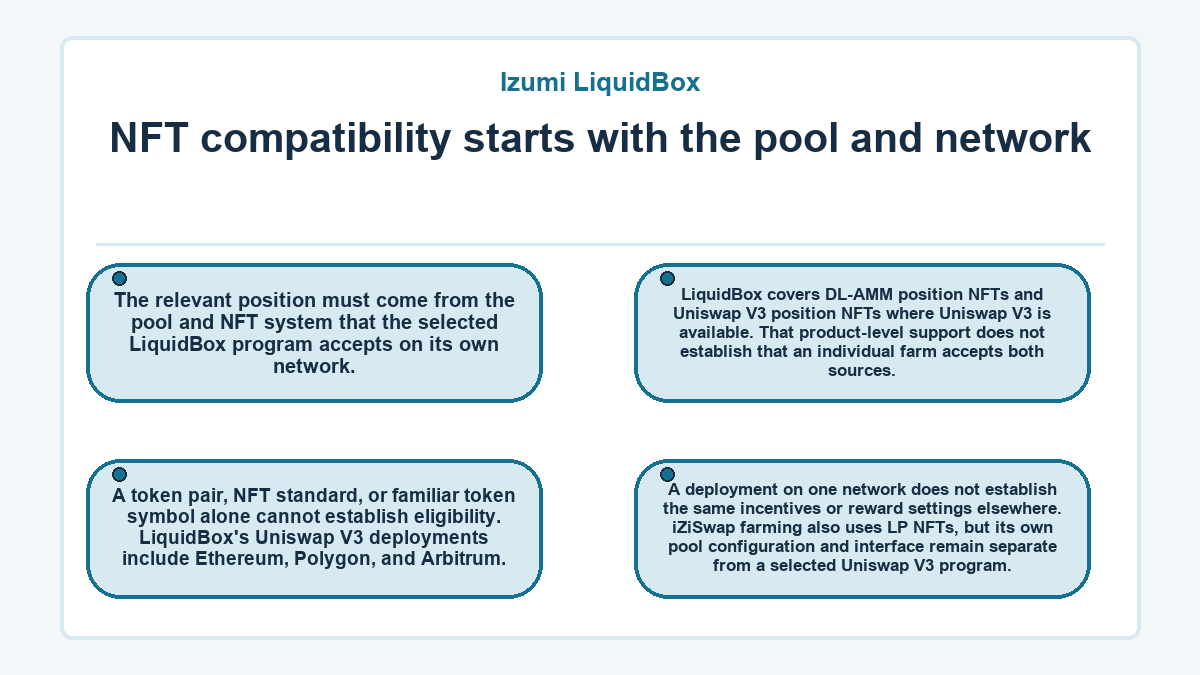
NFT compatibility starts with the pool and network
The relevant position must come from the pool and NFT system that the selected LiquidBox program accepts on its own network. LiquidBox covers DL-AMM position NFTs and Uniswap V3 position NFTs where Uniswap V3 is available. That product-level support does not establish that an individual farm accepts both sources. A token pair, NFT standard, or familiar token symbol alone cannot establish eligibility.
LiquidBox's Uniswap V3 deployments include Ethereum, Polygon, and Arbitrum. A deployment on one network does not establish the same incentives or reward settings elsewhere. iZiSwap farming also uses LP NFTs, but its own pool configuration and interface remain separate from a selected Uniswap V3 program.
Reward-band coverage changes fixed-range weight
In the fixed-range model, a position can cover the whole rewarded band, extend beyond it, or occupy only a narrower part. Equal deposit values do not give these layouts equal incentive weight. A wider NFT range includes liquidity outside the band that the program wants to reward. Only liquidity inside the incentivized band counts toward a wider position's fixed-range reward weight. A position entirely inside the band can face a weighting penalty for its narrower coverage. Consequently, narrowing a range to raise concentrated liquidity does not automatically increase its mining allocation. The relevant comparison uses the position's eligible weight under that program's algorithm.
For the documented Ethereum Mainnet default, matching the reward band's boundaries maximizes mining weight for the same token inputs. The weighting method is customizable, so that relationship should not become a universal rule for every deployment. The NFT's liquidity range and the program's mining reward range remain separate inputs. Uniswap V3 expresses position boundaries as ticks, which divide the price scale into discrete intervals. The weighting algorithm can measure overlap using those tick boundaries. The width of the NFT's entire range and the width that falls inside the reward band can therefore differ.
How is a fixed-range position's reward share calculated?
A fixed-range program allocates rewards in proportion to the position's effective liquidity weight relative to the program's total eligible weight. The raw token deposit and the NFT's identity do not themselves determine a fixed number of reward tokens. The weighting calculation translates position-specific liquidity and range coverage into quantities that the program can compare. This effective measure is also called virtual liquidity.
Where the program distributes a shared reward allocation, a position's fraction equals its eligible weight divided by total eligible weight. Multiplying that fraction by the allocation gives the corresponding share before any applicable boosting rules. The emission allocation can change independently of that proportional weighting. More competing eligible weight can lower one position's fraction even when that position remains unchanged. The project launching an incentive program chooses its reward price range, duration, and quantity of incentive tokens. A scheduled allocation can finish while the underlying liquidity position continues to exist. The NFT's presence therefore cannot establish that the program is still distributing new tokens.
Dynamic Range establishes entry boundaries around the market price
Dynamic Range uses the price when liquidity enters the program to establish a range whose width comes from the selected configuration. That price reference differs from a fixed band chosen around a stable or pegged relationship. The resulting Uniswap V3 position has concrete lower and upper boundaries derived from that entry price. A range multiplier from one configuration does not define every Dynamic Range position.
One-sided deposits divide liquidity support and staking
The one-sided Uniswap V3 model puts USDC below the current project-token price and holds the project-token portion in a separate staking module. Its described arrangement pairs equal deposit values, although the assets serve different functions after entry.
The USDC supplies potential buying liquidity as the project-token price falls through the selected interval. Project tokens held in staking do not enter the pool as potential sell liquidity above the initial price.
During an upward price move, the staked project-token allocation avoids the pool's passive sale of those tokens.
Downward price moves still expose the pool allocation to impermanent loss. For the documented case whose lower price boundary is zero, the combined deposit's downside impermanent-loss percentage matches the constant-product model. That comparison applies to a zero lower bound; a positive lower bound changes the liquidity configuration.
Staked project tokens retain exposure to their own market price. The value of reward tokens can also fall while the number of tokens paid remains unchanged. Assessing a payout therefore requires distinguishing token quantities from the market value of the assets that remain deposited.
Trading fees and mining tokens reward different activity
Trading fees arise from swaps that use a position's active liquidity. Mining incentives come from iZUMi Finance and participating projects under the chosen program. The same position can have both revenue streams, but their accrual conditions differ. A reward token allocation says nothing by itself about how often traders will use the liquidity.
Reward token identity, emission allocation, and the amount of competing eligible liquidity affect mining income. The trading pair and pool fee determine the units and fee conditions for the separate swap income. An annual percentage rate, or APR, expresses a rate relative to capital over a year. It does not set the future quantity of tokens that an NFT will receive.
As Uniswap V3 trades move price toward a position boundary, the token mix changes. At an extreme boundary, the position can consist entirely of one asset. Mining payments accompany that changing exposure; their quantity does not describe the composition of the remaining pool liquidity.
Boosts alter the eligible mining weight
The veiZi boost model can raise the earning weight for mining incentives to at most 2.5 times its unboosted baseline. It uses LP virtual liquidity and the holder's share of voting power in the calculation. Other LiquidBox implementations use an iZi stake for boosting. Holding either asset somewhere in a wallet does not establish that its boost applies to the selected pool.
For veiZi boosting, the calculation caps earning weight at the position's virtual liquidity. The ceiling concerns the incentive mechanism, not a multiplication of deposited assets or the wallet's value. The achieved boost depends on the qualifying stake and the other quantities in the pool's calculation.
A minted NFT and a mining position show different states
Creating a Uniswap V3 position produces an LP NFT before the position enters a fixed-range LiquidBox program through staking. At that point, the position supplies pool liquidity; mining participation still requires the program's staking step. The NFT in the wallet confirms that the liquidity position exists. If LiquidBox has no corresponding mining position, the expected handoff into farming has not completed.
- Use the network and pool that the selected fixed-range program accepts.
- Compare the NFT's price bounds with that program's reward band and weighting rules.
- Confirm that the new LP NFT represents the intended liquidity position.
- Approve the NFT and stake it when the fixed-range interface requires those actions.
- Confirm that LiquidBox shows the corresponding mining position before assessing its reward accrual.
The Dynamic Range Uniswap V3 interface stakes the new NFT automatically after liquidity creation. Its handoff differs from the fixed-range path. A corresponding LiquidBox mining position confirms the handoff from liquidity provision to farming. The reward amount then follows the live allocation and eligible weight; a displayed APR can change.
What happens when price leaves a Dynamic Range position?
The staked Uniswap V3 NFT can continue earning Dynamic Range mining rewards outside its entry range while the incentive program remains active. Its out-of-range liquidity does not earn new trading fees until market conditions bring that liquidity back into use. The recorded price bounds and the mining program therefore describe different conditions.
The model also permits redemption and new liquidity provision around a later market price. Repositioning changes pool exposure and introduces new liquidity-management actions, so it is a separate decision from leaving an eligible NFT staked. A price move alone does not demonstrate that an unfinished reward program has stopped.
Harvesting and exit actions depend on the model
Harvesting collects mining rewards; unstaking removes the NFT from mining. In the fixed-range Uniswap V3 interface, Withdraw is an additional action after Unstake. The Dynamic Range interface describes returning the position and rewards through its Unstake action. Those interface-specific routes remain distinct when interpreting a position's exit controls.
A fixed-range position can therefore remain exposed to its pool after a mining reward claim. Harvesting rewards does not remove its liquidity.
Izumi LiquidBox: frequently asked questions
Can an existing Uniswap V3 position enter a fixed-range LiquidBox program?
An existing Uniswap V3 position can qualify when its NFT satisfies the selected fixed-range program's pool, network, and range-weighting requirements. The staking mechanism uses the LP NFT that represents the position.
Is a Uniswap V3 LP NFT withdrawable after its LiquidBox incentives end?
The Uniswap V3 LiquidBox incentive model permits NFT withdrawals after reward distribution finishes, as well as during the incentive period. The end of emissions and the return of a staked NFT are different events. The relevant withdrawal controls still depend on the selected LiquidBox model.
When can unstaking veiZi reduce a LiquidBox reward claim?
Unstaking veiZi before claiming farming rewards can reduce those rewards in pools that use veiZi boosting. The reduction concerns the unclaimed farming allocation because removing the stake cancels its boost. An LP NFT represents the separate liquidity position, so unstaking veiZi and unstaking that LP NFT are different actions.
Who receives unconsumed incentives when a LiquidBox program redistributes them through veiZi?
Unconsumed incentives go to veiZi holders under that redistribution arrangement. This allocation belongs to the veiZi boosting model and differs from a liquidity provider's own farming allocation. A position's eligible mining weight does not give its owner an unconditional entitlement to the program's unconsumed incentive tokens.
Does a narrow LiquidBox reward band maintain a stablecoin's peg?
A narrow reward band encourages liquidity near the targeted price relationship; it does not fix the market price. The program pays for eligible liquidity in its selected interval. Concentrating that liquidity can improve depth near the peg, while a market move can still carry price beyond the interval.